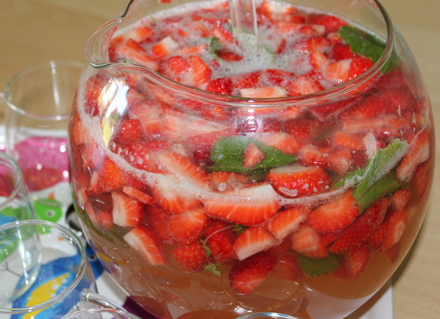
The Reinvention of the "Wein-Bowle"

Most of my regular readers might already guessed it and I might have mentioned it already: I am not the usual German.
But even I cannot dismiss everything from my roots. This is not always apparent, but sometimes it flashed up.

And I don't mean the contemporary German bar culture. This is in full swing - just at this time, there is the BCB - the Bar Convent Berlin, a mixologists' fair, which doesn't only attract Germans anymore - it is an international event and bar personalities are travelling there from around Europe [and some even further]! My career started in Germany and when I left, the raise of the bar was in remarkable.

But everything which is happening in the bar, has strong international [means American] influences and are just supported by some regional variations and regional products. The bar in San Francisco will be more different from the "modern American bar" than the bar, which you can find in Germany.

Long story short, but there is very few things in German bar history, which can be revived, revamped and updated. However I was quite surprised, when I thought about my latest experiment.

I had some quite ripe strawberries in the fridge [I am buying after my nose - even if the strawberries look gorgeous, but smell bland, I won't buy them. Well, unrelated, I do the same with cheese].
And I had a "normal" bottle of rosé wine. 
So what I did is, slicing the strawberries and macerating them in very fine bar sugar. And after that putting them into the Soda Plus - added the wine and charged it with nitro. After that filled it up with ice and put it in the fridge [yes - I run out of CO2 bulbs].
Today I took it out of the fridge and charged it with 2 CO2 cartridges.

And - it tasted very nice. I just added a bit of my "sour syrup" [which is rich syrup with added citric acid] and a bit more sugar. Delicious.
But then it stroke me: I just reinvented the German classic "Wein-Bowle" [which you could translate into wine-punch]. 
Usually wine is infused with fruits, sugar and sometimes herbs and then "stretched" with carbonated mineral water and/or sparkling wine.

And while my recipe was much more contemporary and used modern techniques [and ended up to be much cleaner tasting], it wasn't so far off.
in couresy of www.thekitchn.com

This would be a perfect pre-bottled "cocktail". It would be definitely meet the demand for aromatized wine drinks - but would have only good ingredients and would taste - well, superior to anything which has a minimum of 12 month shelf-life.

So - while it doesn't happen so often, it still happens: You can utilize a common, traditional drink, and update and reinvent it. 

Or maybe I just get into the age, which glorifies the past… you decide...

Comments

Popular posts from this blog

How to use citric acid - and why you might not want to use it anyway!

To be honest, I shied away of this topic, because I think, people can misinterpret this - big time. I don't want to be part of the problem - I want to be part of the solution!  But when Chris, over at A Bar Above  discussed this subject- I literally could not resist to join into "the discussion". Here is the video: I - however take a bit slower approach than Chris. What is citric acid? Chemical Compound Citric acid is a weak organic acid with the formula C6H8O7. It is a natural preservative/conservative and is also used to add an acidic or sour taste to foods and drinks. Wikipedia Formula: C6H8O7 Molar Mass: 192.124 g/mol Melting Point: 153C Density: 1.66 g/cm3 Boiling point: 175C Soluble in: Water Why is it controversial? In my "mixology world" it is controversial, as citric acid is the stuff, which makes the nightmarish sour mix [ preferably in powder form ] sour. Yeah - citric acid is the main ingredient in one of the most ...

Agar-Agar Clarification

Not often, I am posting here things, which are clearly not my ideas... However Dave Arnold is clearly a mad scientist [no, he really is!] - and he posted amazing stuff on his website www.cookingissues.com - no - don't click now - just follow the link later. One of the most impressive posts about mixology, besides of demystifying the mechanics of shaking, were clarification techniques. Look, after him, you could use a centrifuge [which would set you back a couple thousand bucks] and a chemical compound, which solidifies sediments. I am not a fan of that. Then there is gelatine clarification; this works quite well [I tried it several times my self] - you gelatinize a liquid [with little gelatine only], freeze it, thaw it [in the fridge] over a colander and a muslin cloth. Thats it. Unfortunately this has several problems: Gelatine is made out of animal bones - hence it is neither vegetarian nor vegan, which you won't usually expect of a beverage. You have to freez...

Fanta Pineapple

After the agave nectar scandal , nothing seems to be big enough to post about. At it seems odd, that I am coming here to review a commercial and mass produced product. But hey- I do admit, that I love coke and really like some other commercial sodas. I only try to stay away of artificial ingredients. This said, Fanta Pineapple doesn't start a nice relationship with me. While the front states "Pineapple flavored soda with other natural flavors" - the ingredient list looks like a witches brew: carbonated water, HFCS, citric acid, natural flavors, modified food starch, potassium sorbate and sodium benzoate [to protect taste], sodium citrate, coconut oil, salt, sucrose acetate isobutyrate, yellow 5, yellow 6 Well - that doesn't really look like my homemade sodas. Yes citric acid, sodium citrate [a simple product, when you let citric acid and bicarbonate of soda react], carbonated water… this is understandable. HFCS is obviously far cheaper than sugar - this is...